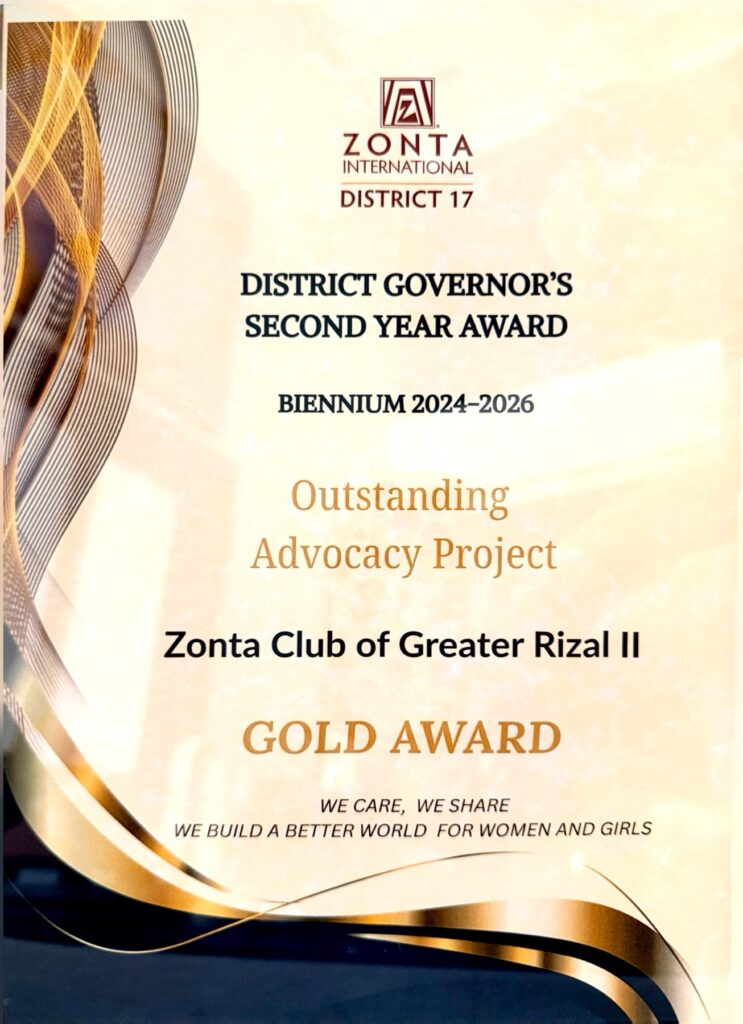
Under the leadership of Immediate Past President Shirley Licup, the Zonta Club of Greater Rizal II proudly received the Most Outstanding Advocacy Gold Award for its flagship fundraising concert, “A Better World with Zonta.” The prestigious recognition highlights the club’s unwavering commitment to advancing Zonta International’s mission of building a better world for women and girls. The fundraising concert served as a meaningful platform to promote women’s rights, dignity, and empowerment while generating support for two vital beneficiaries. Through its partnership with Wipe Every Tear, the club helped provide rescue, restoration, and renewed hope for women who have been exploited in the sex trade. The initiative also extended assistance to Mary Johnston Hospital, contributing to the enhancement of maternal healthcare by supporting the training and accreditation of its Obstetrics and Gynecology residents. More than a successful fundraising event, “A Better World with Zonta” exemplifies the club’s dedication to creating sustainable, life-changing opportunities for women and girls. This Gold Award stands as a testament to the passion, collaboration, and service of the members of the Zonta Club of Greater Rizal II, whose advocacy continues to inspire communities and transform lives.
Category Archives: NEWS
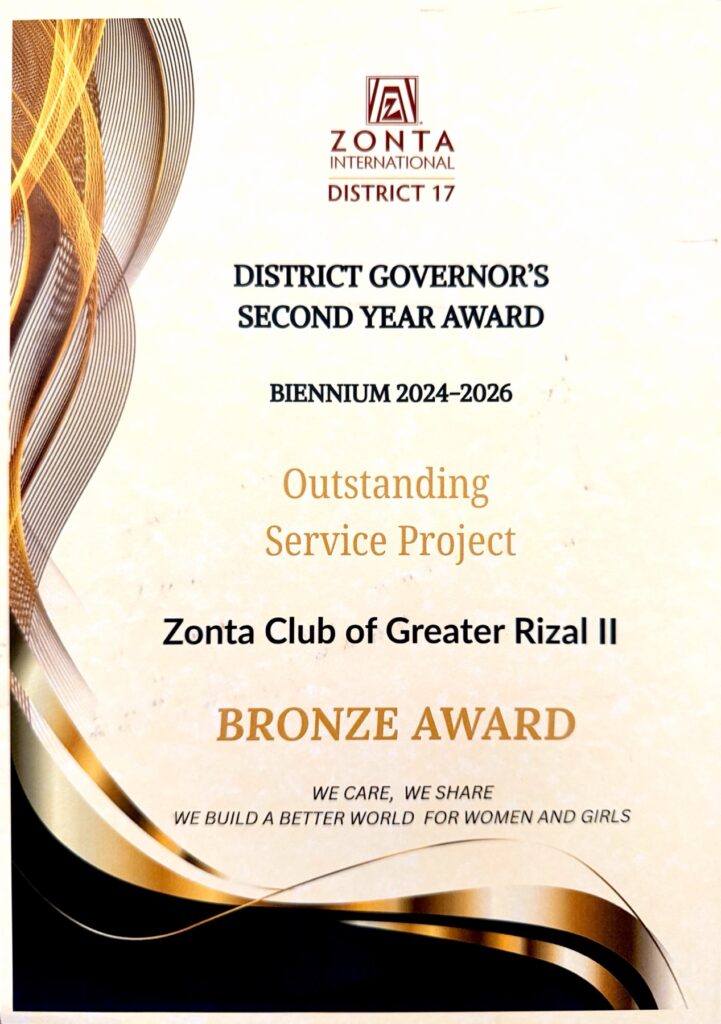
Under the leadership of Immediate Past President Shirley Licup, the Zonta Club of Greater Rizal II was honored with the Most Outstanding Service Project Bronze Award for its impactful “Maning-Mani” (Just Peanuts) Livelihood Project. The recognition celebrates the club’s commitment to empowering women through sustainable, community-based initiatives that embody Zonta International’s vision of advancing women’s rights and enabling every woman to realize her full potential. The “Maning-Mani” Livelihood Project was designed to provide women with practical livelihood opportunities, equipping them with the skills and resources needed to achieve economic independence and self-reliance. By transforming a simple enterprise into a source of income and hope, the initiative has helped improve the lives of women and their families while fostering confidence, resilience, and entrepreneurship. This Bronze Award reflects the Zonta Club of Greater Rizal II’s steadfast dedication to meaningful service and its continuing mission to uplift women through programs that create lasting opportunities, strengthen communities, and inspire a brighter future for all.
Three Zonta Club Projects Featured on Zonta International’s Share-A-Story Platform We are proud to share additional three (now total of five) of Zonta Club of Greater Rizal II’s advocacy and service projects have been recognized and featured by Zonta International through their Share-A-Story platform — a space where local initiatives inspire global action. EARLIER WE SAW: 🚫 ADVANCING ZONTA’S MISSION: SAYING NO TO VIOLENCE AGAINST WOMEN AND GIRLS Two of our major anti-VAWG initiatives were featured for their strong alignment with Zonta’s global mission: Wipe Every Tear (WET)An integrated program combining art therapy, livelihood support, and safe shelter donations for survivors of gender-based violence. Empowerment Thru AwarenessA community-based talk on Violence Against Women and Children (VAWC) and Teenage Pregnancy, focusing on awareness and early intervention.🔗 [Lin NOW: 🌱 ADVOCATING FOR EMPOWERMENT AND THE ENVIRONMENT Three more of our projects — championing both women’s empowerment and environmental sustainability — were also spotlighted: Save Mother Earth: Mangrove Tree Planting – Part 2 (April 29, 2025)A hands-on initiative to help combat climate change while promoting community involvement and environmental stewardship. Women Empowerment Thru Career Opportunities (May 1, 2025)A program designed to provide women with access to skills training, job matching, and career-building opportunities. Debut of Empowering Theme Song at Rose Day CelebrationDuring our 2025 Rose Day event, our club proudly debuted a powerful original theme song that celebrates Zonta’s mission and the strength of women.🎶 As shared by Amy Park of Zonta International, this video will also be featured on Zonta’s official app and social media, expanding its reach worldwide. 💛 Local Actions, Global Echoes We are deeply honored by this recognition from Zonta International, which not only uplifts the spirit of our club members and partners, but also affirms the impact of community-rooted, mission-driven service. #ZontaInternational #ZontaClubGreaterRizalII #ShareAStory #NoToVAWG #WomenEmpowerment #SaveMotherEarth #ZontaRoseDay #LocalToGlobal
Two Zonta Club Projects Featured on Zonta International’s Share-A-Story Platform We are proud to share two Zonta Club of Greater Rizal II’s advocacy and service projects have been recognized and featured by Zonta International through their Share-A-Story platform — a space where local initiatives inspire global action. 🚫 ADVANCING ZONTA’S MISSION: SAYING NO TO VIOLENCE AGAINST WOMEN AND GIRLS Two of our major anti-VAWG initiatives were featured for their strong alignment with Zonta’s global mission: Wipe Every Tear (WET)An integrated program combining art therapy, livelihood support, and safe shelter donations for survivors of gender-based violence. 2. Empowerment Thru AwarenessA community-based talk on Violence Against Women and Children (VAWC) and Teenage Pregnancy, focusing on awareness and early intervention. 💛 Local Actions, Global Echoes We are deeply honored by this recognition from Zonta International, which not only uplifts the spirit of our club members and partners, but also affirms the impact of community-rooted, mission-driven service. #ZontaInternational #ZontaClubGreaterRizalII #ShareAStory #NoToVAWG #WomenEmpowerment #SaveMotherEarth #ZontaRoseDay #LocalToGlobal
For far too long, Filipino women have carried the weight of inequality in silence—locked out of financial systems, overburdened by care work, and underrepresented in decision-making spaces. But make no mistake: the winds are shifting. Across the Philippines, from barangays to boardrooms, efforts are underway to level the playing field and unlock the transformative power of women’s economic potential. The road is long, and the work is far from done. But change is not only possible—it’s already happening. Let’s take a closer look at how the Philippines is addressing the structural barriers holding women back from full economic empowerment. Legal Frameworks Supporting Women’s Economic Rights The legal foundation for gender equality in the Philippines is among the strongest in Southeast Asia—and that’s no small feat. The Magna Carta of Women (Republic Act 9710), passed in 2009, was a watershed moment. It guarantees women’s rights to equal treatment in the workplace, participation in development, and access to education and health services. It also mandates gender mainstreaming in all government agencies and local government units (PCW). Complementing this is the 105-Day Expanded Maternity Leave Law (2019), which extended paid maternity leave from 60 to 105 days—one of the longest in Asia (World Bank). This law acknowledges the dual roles women play and provides crucial support for working mothers. But policy without enforcement is a paper tiger. Advocates now push for stronger implementation and accountability mechanisms to make sure these hard-won rights translate into real-world change. Financial Inclusion Initiatives Access to finance remains one of the biggest hurdles for women—but the gap is narrowing, thanks to both public and private sector interventions. Women’s World Banking, a global nonprofit, has pioneered programs that deliver digital financial services tailored to women’s needs, including mobile banking, micro-loans, and insurance products (Women’s World Banking). On the government side, the Gender and Development (GAD) Budget Policy mandates that at least 5% of all national and local budgets be allocated to gender-responsive programs (PCW). While not perfect in implementation, it’s a strong step toward systemic financial inclusion. Moreover, the Bangko Sentral ng Pilipinas (BSP) has launched initiatives aimed at increasing women’s access to banking and credit, including policies that support microfinance institutions catering to women entrepreneurs (ADB). Support for Women Entrepreneurs Filipino women are some of the most entrepreneurial in the world, with over 50% of MSMEs led by women (UN Women). But they still face massive hurdles in scaling their businesses. The Philippine Commission on Women (PCW) has spearheaded the GREAT Women Project, which offers targeted support including: Skills training in business management Product development assistance Linkages to local and international markets Access to credit and capital(PCW) Meanwhile, the Investing in Women Asia program focuses on unlocking private sector investment in women-led enterprises by addressing the barriers to capital, mentorship, and market access (Investing in Women). These programs are more than just economic interventions—they are lifelines for women seeking to transform their potential into power. Addressing the Unseen Barrier: Unpaid Care Work Unpaid domestic labor is one of the most persistent—and least visible—obstacles to women’s full economic participation. In response, there’s growing momentum for state-supported childcare services that allow women to enter and stay in the workforce. The government is exploring tax incentives for companies that build or provide childcare facilities, a forward-thinking solution that could dramatically reduce the care burden placed disproportionately on women (ADB). There are also grassroots initiatives piloting community-based childcare cooperatives, particularly in rural and underserved communities. These efforts recognize care work not as a private issue, but as a public policy priority. Promoting Women in Leadership and Decision-Making True economic empowerment isn’t just about income—it’s about influence. The Philippines has made strides in promoting women’s political and corporate leadership, but gaps remain. Programs now target increasing women’s representation on corporate boards, in executive roles, and within policymaking bodies. The PCW and civil society groups continue to advocate for mandatory gender quotas in certain public institutions—an idea gaining traction in other Southeast Asian nations as well. Building a Cultural Shift No amount of policy can succeed without cultural transformation. Organizations, schools, and advocacy groups are actively working to change mindsets—challenging stereotypes that paint women as secondary earners or caregivers by default. Campaigns are encouraging men to take on more caregiving responsibilities and redefining masculinity in ways that support gender equity. As we dismantle outdated norms, we create a society where equality is normalized, not exceptional. The Path Forward: Sustaining Momentum So where do we go from here? We must push for: Stronger implementation of existing laws and policies Expanded investment in gender-responsive programs Increased accountability from both government and private institutions Continued grassroots mobilization to keep women’s voices front and center Women’s economic empowerment is not a footnote to development—it is the headline. And the momentum we’ve started must not stall. As we aim for inclusive, resilient, and sustainable growth under AmBisyon Natin 2040, we must remember: empowering women is not just the right thing to do—it’s the smartest economic strategy we’ve got.
Despite the clear economic and social benefits of women’s economic participation, many Filipino women remain trapped in a cycle of financial dependence and marginalization. It’s not for lack of ambition or ability—it’s the weight of deeply entrenched, systemic barriers that hold them back. If we’re serious about unleashing the full potential of the Philippine economy, we must confront and dismantle the obstacles that prevent half our population from fully participating in it. Women aren’t asking for favors. They’re asking for fairness—and it’s time we listen. The Financial Exclusion of Women Entrepreneurs Let’s begin with one of the most glaring contradictions: women make up 53% of all micro, small, and medium enterprises (MSMEs) in the Philippines (UN Women), yet they face disproportionate challenges in accessing capital. Globally, the financing gap for women-owned businesses is estimated at $300 billion—and the Philippines is far from immune. A key culprit? Collateral requirements. In a society where land and property ownership still skews heavily toward men, women often don’t have the assets required to secure loans (ADB). The result is devastating: women-led businesses are forced to stay small or close entirely—not for lack of potential, but for lack of resources. Imagine the jobs that could be created, the innovation that could be unleashed, and the communities that could thrive if these barriers were removed. The Heavy and Invisible Burden of Care Work Then there’s the issue no GDP report can fully quantify: unpaid care work. Filipino women spend an average of 13 more hours per week on unpaid domestic labor than men (PIDS). That’s nearly two full workdays lost—every single week—to tasks that are essential to family well-being but undervalued by the formal economy. This “invisible labor” limits women’s time for education, paid employment, or entrepreneurship. And when childcare options are inaccessible or unaffordable, women are forced to choose between their careers and their children—an impossible decision with long-term economic consequences. Wage Gaps and Job Segregation Even when women do break into the workforce, they encounter an uneven playing field. Women in the Philippines earn 18.4% less than men, even in sectors like digital work where equal access should, in theory, be achievable (World Bank). This isn’t just about a wage gap—it’s about value perception. Women are frequently clustered in lower-paying, lower-complexity jobs, despite having higher educational attainment on average than men. Structural inequalities and cultural norms continue to funnel women away from leadership roles and into roles that are underpaid and undervalued. Occupational segregation isn’t accidental—it’s systemic. Until we address the root causes, we will continue to see women stuck in the margins of economic progress. Gender-Based Violence as an Economic Issue Perhaps the most painful, and often overlooked, barrier to women’s economic empowerment is gender-based violence (GBV). Women experiencing abuse are often financially dependent on their partners, making it difficult—if not impossible—to escape toxic or dangerous situations. Economic disempowerment and GBV create a vicious cycle: one feeds the other, keeping women trapped (PCW). While the Philippines has strong legal protections such as the Anti-Violence Against Women and Their Children Act of 2004, we must recognize that economic empowerment is a form of protection. Women with access to income, property, and support networks have greater freedom, security, and decision-making power. Limited Access to Technology, Information, and Support Systems Access to capital is just the tip of the iceberg. Women in business also face: Limited access to digital tools and business technologies High transaction costs when seeking credit or training Lack of awareness about business development services Scarcity of mentorship networks Lower representation in high-value industries These barriers are even more severe in rural areas and among indigenous women, where intersectional discrimination compounds economic marginalization (Borgen Project). The cumulative effect? Even the most promising women entrepreneurs are left under-equipped and under-supported, despite their proven resilience and creativity. Cultural Expectations and the Double Standard Filipino culture has long celebrated the strength and sacrifice of women—but often at the cost of their personal freedom and economic mobility. Traditional gender roles continue to dictate expectations: women are caregivers first, professionals second. These societal norms act as invisible chains, shaping everything from job prospects to self-confidence. Economic empowerment requires not just programs and policies—it requires a cultural reckoning. We must stop romanticizing sacrifice and start recognizing women as equal economic agents with the right to pursue wealth, leadership, and autonomy. Conclusion: Breaking Down the Barriers The road to economic freedom for Filipino women is still riddled with structural roadblocks—but each barrier we name is one we can begin to break. From financial exclusion and care burdens to wage inequality and cultural bias, these challenges are deeply embedded—but not immovable. What we need now is bold political will, grassroots advocacy, and a national mindset shift that treats women’s economic power as central—not peripheral—to the country’s growth. Because when women rise, nations rise with them. It’s not just about equality—it’s about survival, progress, and prosperity for all.